Back
Lets talk about bats
Habitat
Presented by Lawrence Pope
Fun facts On Australia’s Grey headed Flying foxes (Pteropus poliocephalus):
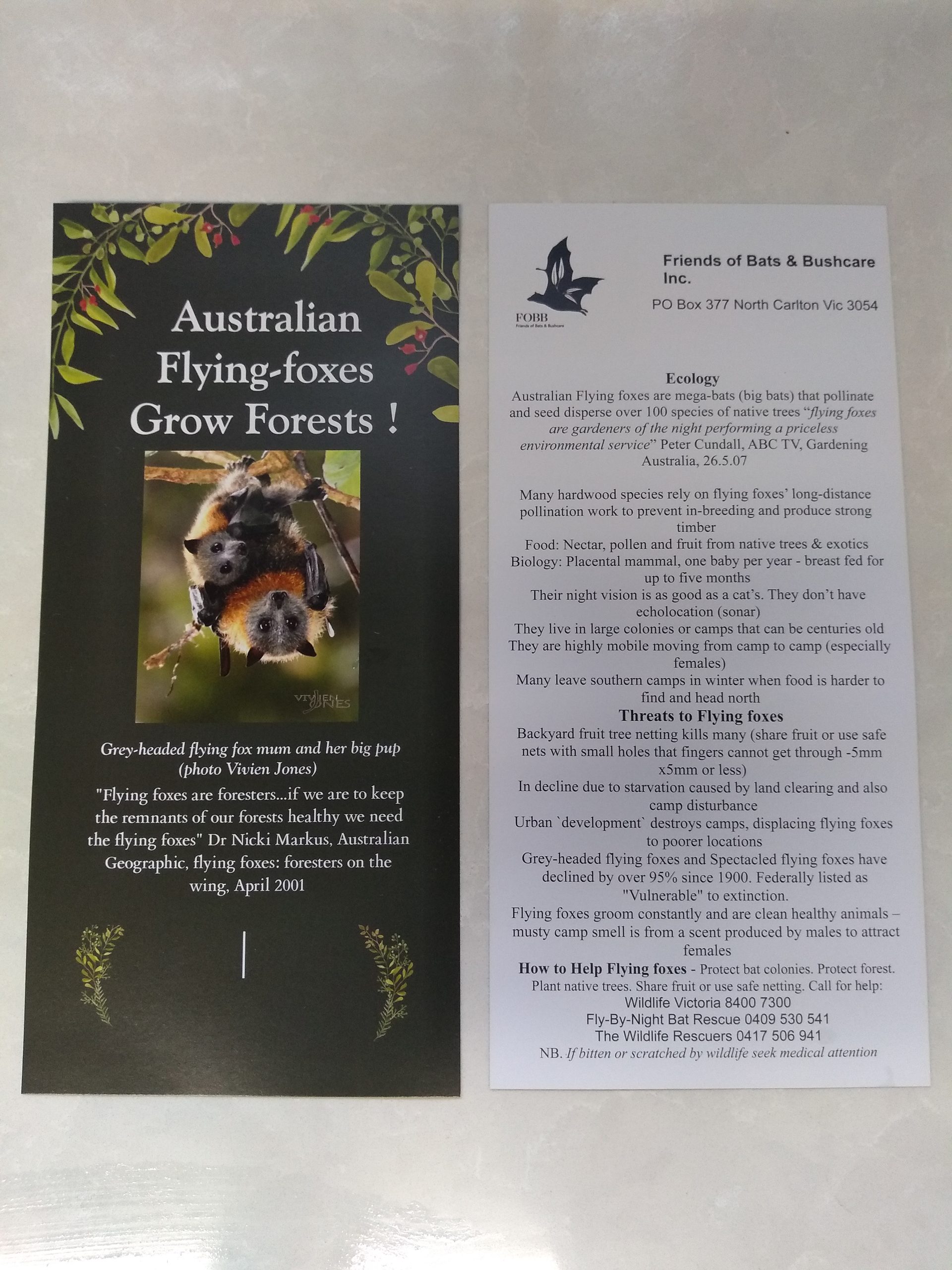
- Flying foxes are mega-bats (big bats) belonging to the order megachiroptera (big hand wing).
- They have no sonar/echolocation. They are sight (eyes) and (ears) sound bats.
- Their night vision is a good as cats, great hearing and a powerful sense of smell.
- They pollinate over 100 Species of Native Trees and Plants across vast areas.
- Their long distance environmental works aids in healthy landscape regeneration and prevents inbreeding of native fruiting. and flowering tree species.
- Their diet is nectar, pollen and fruit.
- They are placental mammals having one pup per year that they breast feed for up to five months.
- Baby bats dream and suffer from hiccups. They call for their mum with a chittering sound.
- Bubs stay on their mum 24/7 for the first month (attached to a nipple and with feet hanging on to mum’s side) then, when they are too heavy to carry out, they are crèched in camps together – they are picked up and fed in the morning when mum returns to camp and remain with her all day sleeping, feeding, playing and grooming.
- Flying foxes are clean healthy animals that groom constantly.
- They live in large, sometimes mixed species camps, up to 100,000 animals strong.
- Flying foxes move camps individually in response to food availability (flowering and fruiting).
- The musty smell of flying fox camps is male scent gland on shoulder rubbed on tree branches to attract females during mating season.
- They are likely to be in some decline due to widespread land-clearing and climate change (heat waves, fires, and excess rain causing starvation).
- Urban human-made threats kill thousands each year and include barbed wire and unsafe `large aperture` fruit tree netting (wildlife safe mesh size is 5mm x 5mm or less), electrocution on powerlines and illegal camp dispersals.
- Not only are flying foxes major pollinators they maintain vegetation and habitat for other key pollinators of agricultural crops and native bush i.e. bees, insects and birds.
- State and Federal Government is increasingly engaged in flying fox conservation as they recognizes the landscape regeneration and carbon sequestering value of megabat (flying fox) species.
- Australian flying foxes are “deep indigenous” (pre-dating humans) species building Australian forest and landscapes for at least three million years.
- Range is mainly within 200kms of the coast and includes SA, Vic, NSW, ACT, and Queensland.
- Leaving at dusk flying foxes fly up to 100 km each night in search of food – nectar, pollen and fruit. They return to their roost / camp before sunrise each morning.
- About ten percent transit to and from other camps each night.
- Flying fox camps can be many hundreds of years old. They as central to the bats life as a bee hive is to a bee. And, like bees, there can never be “too many” or “too few” bats in a colony there are just as many as there are!
- The camps are best viewed with binoculars. It is best to stay out of bat camps as human presence disturbs their rest, nursing and social behaviors.

“Flying foxes are gardeners of the night performing a priceless environmental service” Peter Cundall, ABC TV, Gardening Australia, 2007
KIDS: Questions:
- Why do FFs hang upside down? Ans: Hanging upside down is the most energy efficient way to roost on a branch. Birds have a “hang on” with their feet in storms… not bats they can just stay asleep and sway with the breeze.
- Where do they fly at night? Ans. Like us they return to their favourite breakfast spot the night before and once the tree stops flowering or fruiting they go elsewhere…sometimes they need to travel hundreds of kilometres to find another place where there is good food (flower nectar, pollen or fruit).
- Where do they go in winter and how do they know where to go? Ans: The whole species trends south in summer and north in winter. They do to where the trees are more likely to be flowering and fruiting. They’ve done this for millions of years to it is instinctive to them. They can also “smell” the nectar of large flowering of eucalyptus from hundreds of kilometres away and will depart in large numbers to feast on their sugary blossoms.
- What do they eat? Ans. Nectar, pollen and fruit. The trees feed the bats and the bats help the trees reproduce.
- How many live in the average colony? Ans. These days there may be up to 50,000 in a single colony but in times past there could have been 500,000.
- How do they go to the toilet? Ans. They pull themselves upright on their thumb claws and do their business to stay clean and then drop down to their normal upside down position. Otherwise it’d be very messy for them indeed…or course babies do get very messy before they learn to do this and must be clean up by their mum or their human carer. It is a great joy “Hurrah! Clever bub!” when bubby does its first right-way-up (inversion) to toilet!
- How can I help bats? Don’t use nets on fruit trees! Or, share backyard fruit and use only safe netting (holes 5mm x 5mm or less. The smaller the better).Growing trend: Zip mesh/washing bags over fruit you can reach while leaving high fruit for wildlife. Good karma! Defend local forest and bush – Care for Country!
NB: Normal hygiene rules apply to bat urine and poo / faeces eg. soap and water.
If bitten by a bat or any wildlife seek medical attention.
NB: Always call local state wildlife rescue for bats found on the ground or in need of assistance EG: Victoria: Wildlife Victoria 8400 7300 / Fly By Night Bat Rescue 0409 530
NB: Golden Rule with Wildlife is No Touch = No Risk
Further Reading:
Australian Bats, Sue Churchill, Reed New Holland, 1998
Fruit and Blossom Bats of Australia, Les Hall, Greg Richards, UNSW Press, 2000
Flying foxes are protected by law – disturbing or harming them is an offence