




Espalier techniques for fruit trees
Presented by Scott Hitchins
Espalier: while it might sound like a spell that Harry Potter uses to prune his trees, it is actually a method of shaping trees into a more two-dimensional form to fit a narrow space or near a wall or just because you can. Training the branches to horizontal encourages the development of fruiting sites. Peaches are not suited to espalier due to the need to keep replacing wood.
Branches are tied to wires running at about 300mm intervals. Any branches heading outwards that cannot be tied back, are pruned off. Each of the side branches can be grafted to a different compatible variety. Avoid using fences as supports as the tree will outlast the fence by decades. Brick walls are good for plants that are frost tender.
Which fruits are suitable to espalier?
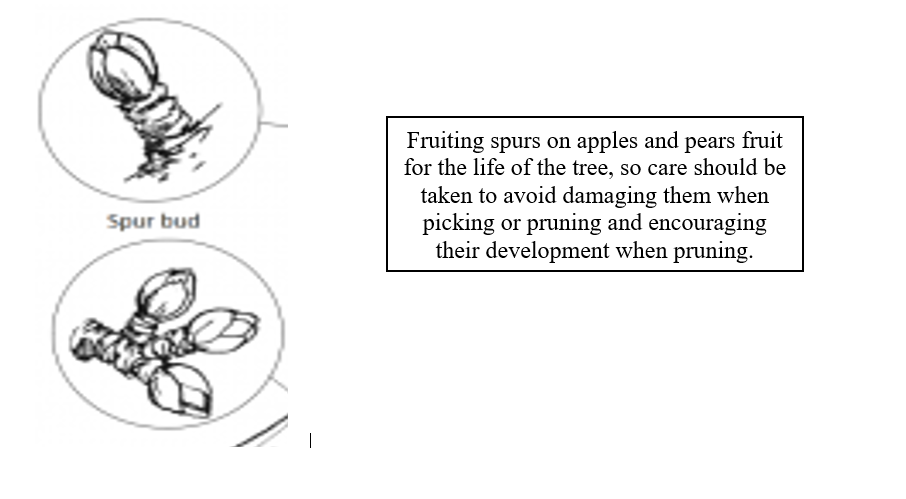
Pomes: Apples and Pears, Nashi :Develop spurs which fruit for the life of the tree Very Suitable. A few apples are tip bearers and are not suitable.
Most Stone fruit: Apricots, plums (Euro & Japanese), cherries, almonds: These develop cluster buds which continue to bear fruitfor many years, developing more as they get older. Suitable, but can be brittle and can snap when tying.
Peaches(and nectarines): These fruit one year old wood which you replace every year. They will bear during their early years and then stop. Not suitable to espalier.
Citrus, Olives and most other evergreens: Best suited to informal and fan shapes.
Pruning and Shaping:
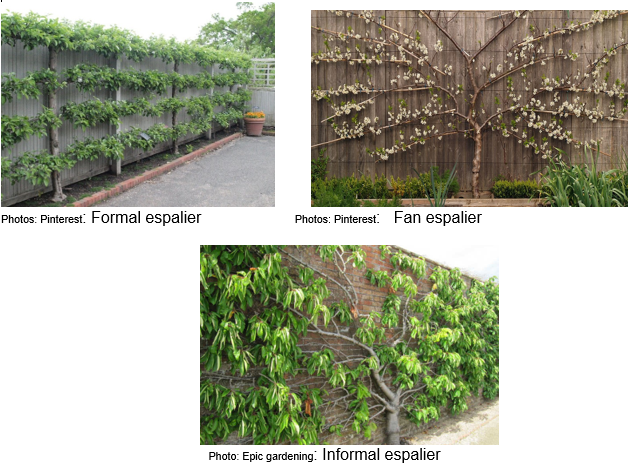
A Formal espalier will most commonly consist of a central vertical trunk with branches trained down to horizontal by tying them to horizontal wires. Any branches that don’t fit into these two dimensions should be pruned off throughout the year Once the central trunk reaches the top of your frame, the top (apical bud) should be cut off. This will direct the tree’s energy into developing the horizontal branches: more branches and more spurs or cluster-buds.
Once you have the tree’s structure in place, Pruning becomes a simple matter of pruning off anything that isn’t part of the structure and trimming the growth coming off each horizontal branch so that it doesn’t impact on the branch above or below it, while encouraging and maintaining buds and spurs. Informal and fan espalier types follow the same rules but require more decisions to be made.
Other espalier-like techniques which may interest you are Cordons, Step-overs, and Pleaching/Braiding.
Grafting on other varieties of fruit:
As your espalier develops, it is possible to graft on other varieties of the same fruit. You can replace very branch on your apple tree with a different variety of apple for example. There is limited scope for compatibility if you are hoping to grow apples and pears on the same tree and it would quite a high level of skill and knowledge, using suitable ‘inter-graft scion’. Pears and Nashi will happily share a tree and there is high compatibility between plum varieties, particularly if you separate Japanese and European varieties (both will grow on the same rootstock, but not necessarily on each other) and grafting oranges onto plums, or other cross-species ‘Frankenfruit’, is not possible.
Grafting involves taking a piece of a named variety of fruit tree and attaching it to some rootstock. This will give you a fruit tree that produces fruit identical to its parent tree e.g., a Granny Smith apple or a Golden Queen peach. However, you also have a choice of rootstock that will give your new tree other qualities such as resistance to disease or pests or keeping the tree to a smaller size.
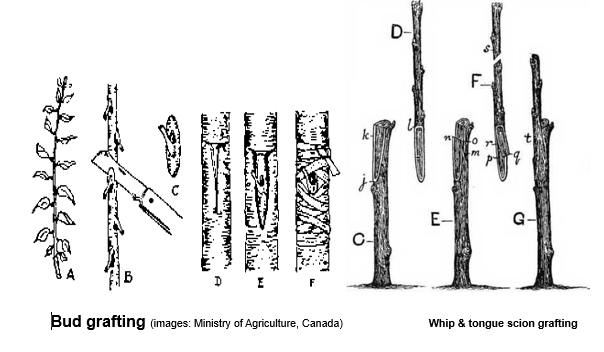
The two main types of grafting are Bud Grafting and Scion Grafting. Bud Grafting, mostly done for stone fruit, involves slicing a single bud from a young piece of wood from the parent tree and inserting it into an incision in the bark of the rootstock and then taping it with grafting tape until the wound is healed. This is mostly done in late summer / early autumn while the tree is still actively growing. Scion Grafting, which is usually done in winter while deciduous trees are dormant, involves attaching a ‘stick’ of approximately 15cm to the rootstock. This is the preferred method for apples and pears. The attachment is done via matching Whip and Tongue grafts in both the scion and the rootstock. It is important to remember that these techniques, while they tend to work best at the times suggested, are still well worth having a go if you happen to obtain a bit of suitable wood from a tree that produces the fruit of your dreams.
Additional Notes and Links:
Espalier video: https://www.youtube.com/watch?v=vTFmdNF1zXk&feature=youtu.be&fbclid=IwAR0vD6C68RPzZ8subg3xLVlZI6e7F0v1XxJNVdLLWbNJAksVeMwaNakpus4
Werribee Park Heritage Orchard: https://www.facebook.com/groups/132782620125733/
Website: http://werribeeparkheritageorchard.org.au/